The alternatives already exist: Sir Norman Lamb on building a more human mental health system
12 November 2026
Long waits, rising detentions and people sent far from home are often treated as fixed features of mental health care. Sir Norman Lamb points to services, here and abroad, that show they need not be.
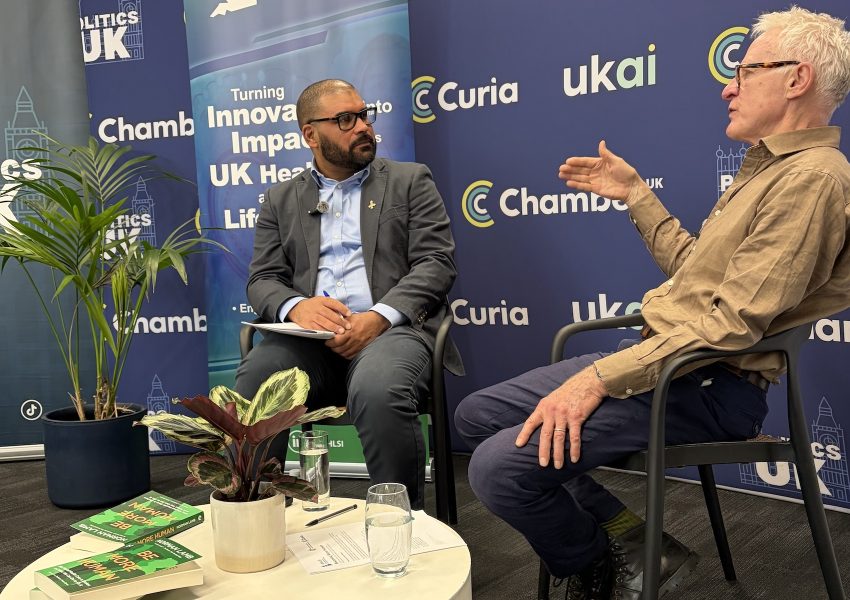
Sir Norman Lamb spent 18 years as an MP, nearly three as Minister of State for Care and Support, and went on to chair South London and Maudsley NHS Foundation Trust. In conversation with Steve Gilbert OBE at Becoming More Human, hosted by Thalamos with UK Healthcare and Life Sciences Innovation (UKHLSI) and Politics UK, he set out the argument of his book, Be More Human: Why Mental Health Care is Broken and What We Can Do to Fix It.
See bottom of this article for a full video of the Becoming More Human event featuring Sir Norman Lamb.
Sir Norman spoke openly about how close to home the argument sits. When his teenage son was diagnosed with obsessive compulsive disorder, the family were told it could be six months before anything happened. They paid for care that, as he pointed out, most families cannot afford. Some years later, his older sister Catherine died by suicide, months after a ten-week stay on an inpatient ward. “The case that I make for change is born out of real personal experience,” he said. However, the book pairs lived experience with a critique of how the system works, and much of what he described is borne out by the data.
Waiting is not a neutral act
As an MP, Sir Norman was regularly approached by constituents desperate about loved ones left waiting, including two teenagers who waited a year after referral. For young people, he stressed, the damage is not only to their health. “It’s your education as well.” A service that leaves people waiting that long, he said, “is sort of like no service at all. It’s not an effective response to need.”
The scale is considerable. The Royal College of Psychiatrists reports that 550,610 children and young people in England are on waiting lists for mental health treatment.
The consequences reach well beyond the clinic. The link between mental health, education and life chances is central to Alan Milburn’s review of young people and work. Its interim report, published in May, found nearly one million young people are not in education, employment or training, and pointed to rising mental ill health as a key driver. The final report is due shortly.
Sir Norman pointed to a Norwegian service that ran for a decade with an open door, no diagnosis and no waiting list. “It completely undermines the belief we have in this country that waiting lists are inevitable. They are not.”
Governed by risk
One of the questions at the heart of the book is why, when people are in crisis, services “so often, almost routinely, respond with coercion and institutionalisation”. Sir Norman recognised that detention is sometimes necessary, “but we do it far too much”. The latest NHS figures record 56,461 new detentions under the Mental Health Act in 2025/26, up 7.1% on the year before, and NHS England notes the true total is likely to be higher because not all providers submitted complete data. Yet he argued there has been no comparable rise in serious mental illness among adults.
“The system is governed by risk rather than understanding someone’s life story,” he added. Detention, he argued, can re-traumatise people, and it is followed by a dangerous period after discharge. The National Confidential Inquiry into Suicide and Safety in Mental Health estimates that 205 people died by suicide within three months of leaving inpatient care in 2023, 12% of all patient suicides, with the highest risk in the first one to two weeks.
Sir Norman contrasted this with a unit in Norway featured in the book, where people with psychosis can seek medicine-free treatment. The emphasis is on activity, music and art, the door is not locked, and no one has taken their own life there. “It’s not a ligature point that ends in suicide, it’s desperation,” he said. Stripping wards of every ligature point and soft furnishing, he argued, leaves them clinical and alien without keeping people safe.
Gilbert, former Vice Chair of the Independent Review of the Mental Health Act and himself detained under the Act in 2010, described what admission takes away. “Even if it’s a couple of weeks, you are ripped away from your community.” Being made to feel like “a problem to be managed”, he added, erodes the hope of recovery.
For some, that separation is measured in miles. Sir Norman described a person in crisis taken by van in the middle of the night to a unit 100 miles from home, and held there for over a week. “We treat people in a cruel and inhuman way, paid for by the state,” he said. Nuffield Trust figures show 301 inappropriate out-of-area placements began in June 2026 alone, and more than half of patients placed out of area in 2024 were sent 100km or more from home.
Unequal treatment, eroded trust
Sir Norman devotes a whole chapter of the book to disproportionality and discrimination. When Gilbert raised the over-representation of black people on secure wards in big cities, Sir Norman recalled Olaseni Lewis, who died in 2010 after being restrained face down by police officers during a voluntary admission. “When that happens in a community, should we be surprised that they’re dubious about connecting with mental health services?”
That fear, he explained, shapes the choices families make. Parents decide “I’m not going to take our son there”, afraid he will end up locked up, or worse. Sir Norman pointed to data showing that black teenagers are significantly less likely to access early support. “Well, what a surprise,” he commented.
The pattern is just as visible at the other end of the system. The same NHS figures show the detention rate for black or black British people in 2025/26 was nearly four times that of the white group, and their rate of community treatment orders was over six times higher.
Sir Norman argued that trust has to be rebuilt by changing where services are and who delivers them, citing a black psychologist who runs a walk-in service in a Croydon shopping centre, where anyone can see him without a referral. “One of the keys to the change we need to make is open access, continuity of care, relational approach, not transactional, shunting people from pillar to post,” he said.
Mind and body
Sir Norman also challenged the separation of mental and physical health care. “We fatally neglect the physical health needs of people with serious mental ill health,” he said. People are dying 15 to 20 years earlier, often from conditions that “either haven’t been diagnosed or haven’t been treated”. “That’s scandalous, and we’ve known about this for years, and the gap is widening.”
Analysis by Rethink Mental Illness found that people with severe mental illness are 4.8 times more likely to die before 75. Centre for Mental Health analysis of government data shows the gap growing: people with a mental illness were five times more likely to die before 75 in 2018–20, up from 4.6 times in 2015–17.
What better looks like
Sir Norman argued that the threat of being detained can keep people silent. In the book, a man given the pseudonym Liam describes deliberately not telling his GP what was going on in his head, because he feared being put back into the system. “We create an incentive for people either not to engage or, if you do engage, not to disclose,” he explained.
Open Dialogue, introduced to the UK by psychiatrist Russell Razzaque, involves open, non-hierarchical conversations with the person and anyone they choose to bring. Razzaque has told Sir Norman that people who go through it often say it is the first time they have ever spoken openly to a psychiatrist. In the ODDESSI trial, published in The Lancet Psychiatry, 21% of people offered Open Dialogue were admitted to hospital over two years, compared with 44% receiving usual care. The trial’s primary measure, time to relapse, showed no significant difference, but the fall in admissions is striking.
Sir Norman’s other touchstone is Trieste, where open-door community centres offer continuity of care with no referral and no discharge. “This is not rocket science. It’s the sort of thing that any of us in this room would want if we were in a state of distress.”
That model is beginning to arrive. In August, the government announced £343 million for up to 159 new NHS mental health centres, including 100 community centres offering walk-in support without a referral. Sir Norman welcomed it, but also wants change from the ground up, with staff who build relationships rather than keep a professional distance.
Gilbert closed by repeating Sir Norman’s own words: “If we have the will, it is absolutely possible.”
Full video of conversation between Sir Norman Lamb and Steve Gilbert OBE
Stay up to date with insights like this one by following Thalamos on LinkedIn or joining our mailing list.