Tomorrow (10 July 2026) marks the closing date for submissions to the government’s call for evidence on a new Mental Health Strategy for England.
Consultations like this are only one part of the policy process as their real value lies in creating an opportunity for people across the mental health ecosystem to share what they have learned and contribute to the direction of travel for everyone. That matters because no single organisation has the full picture.
Mental Health Trusts, Local Authorities, police forces, ambulance services, acute hospitals, schools, housing providers, charities, researchers, people with lived experience and technology partners all experience the system differently. Each sees challenges that others may never encounter and each develops approaches that could help others facing similar problems.
If the next decade of mental health reform and change is to deliver meaningful improvement, those experiences cannot remain isolated. They need to be shared, challenged and built upon.
At Thalamos, we have submitted our own response to the consultation. It reflects what we have learned from working alongside NHS organisations, Local Authorities, police forces and many others who are committed to improving mental healthcare. Our perspective is only one among many, but contributing to that collective conversation feels important.
Learning from one another
If one lesson has become increasingly clear for us at Thalamos it’s that improving mental health services is rarely about a lack of commitment. Across the organisations we work with, we see dedicated professionals who understand what good care looks like and work tirelessly to deliver it. More often, the barriers are found in the way services connect with one another.
Care now extends well beyond the walls of any single organisation. Recovery can depend on housing, education, employment, social care or support from the voluntary sector just as much as clinical treatment. That means responsibility is increasingly shared, yet the systems supporting professionals have not always evolved at the same pace.
Looking beyond organisational boundaries
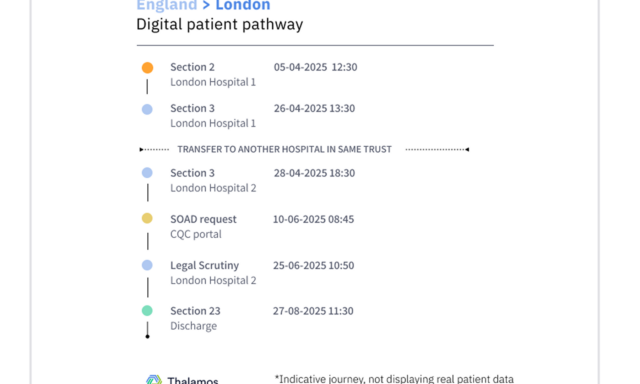
Too often, continuity still relies on individuals knowing who to call, remembering where information sits or working around processes that were never designed for joined-up care. When this happens, organisational boundaries become part of the patient’s experience, even though they should be invisible.
The challenge then is not simply to create more services, but make existing services work together more effectively.
That requires operational foundations that support collaboration rather than hinder it. Professionals need confidence that information can follow the person safely across organisational boundaries. They need a clearer understanding of where responsibility sits at different points in a pathway. They also need better visibility of what is happening beyond their own organisation so that problems can be identified before they become crises.
Technology has an important role to play in making this possible, but not because technology is the objective. The most valuable digital tools are those that reduce friction within the system. They help professionals spend less time navigating administrative processes and more time supporting people. The same principle applies to artificial intelligence. Its greatest contribution is likely to come from supporting professional judgement rather than replacing it, allowing clinicians to focus their expertise where it adds the greatest value.
Understanding what the data is telling us
Mental health services generate huge amounts of information every day so the challenge is rarely a lack of data. Instead, we believe it is understanding what that information is telling us. Better data should not simply produce more reports or larger dashboards. It should help us understand why some pathways work better than others, where delays are emerging and how services can respond before problems become embedded.
The same principle applies to prevention because mental health rarely deteriorates overnight. There are often opportunities to recognise that someone’s circumstances are beginning to change, whether that is through disengagement, instability or increasing complexity. The earlier services understand those changes, the greater the opportunity to respond before crisis develops.
Building the next decade together
None of these observations, which formed part of the Thalamos consultation submission, belong to one organisation. They have emerged from countless conversations with clinicians, Approved Mental Health Professionals, Mental Health Act administrators, police officers, NHS leaders, researchers, people with lived experience and many others working to improve mental healthcare every day.
That is why consultations like this matter. Not because any single submission will define the next Mental Health Strategy, but because they encourage organisations to contribute what they have learned for the benefit of the wider system. We all know that the strongest strategy will not come from one perspective, but will instead emerge from bringing together many different experiences and allowing them to inform one another.
Tomorrow’s submission deadline marks the end of the consultation, not the end of the conversation. The next Mental Health Strategy will set an important direction, but its success will ultimately depend on what happens afterwards. It will rely on organisations continuing to share evidence, challenge assumptions and learn from one another as implementation unfolds.
That spirit of openness is one of the sector’s greatest strengths. If we can build on it over the next decade, we will be in a much stronger position to create mental health services that feel genuinely connected from the perspective of the people who depend on them.
Stay up to date with insights like this one by following Thalamos on LinkedIn or joining our mailing list.
Read more about mental health reform and change: