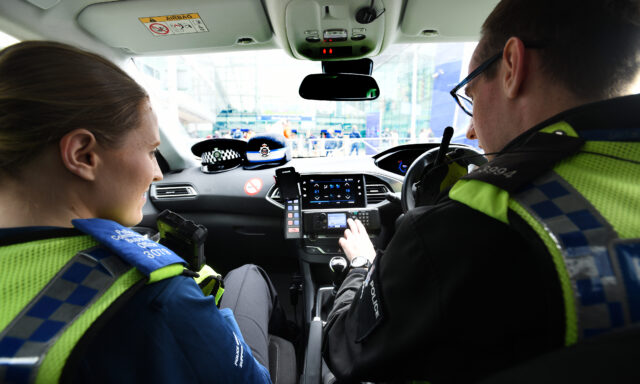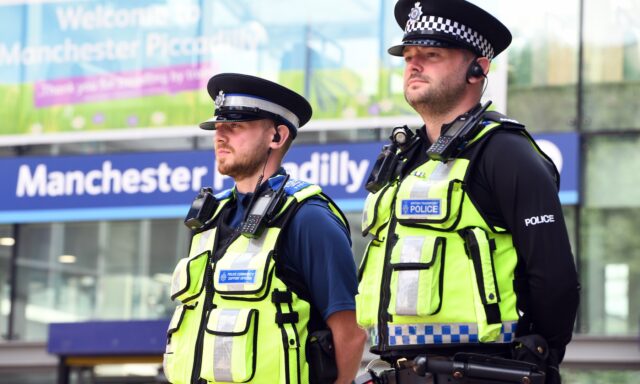
Few public service challenges test partnership working more severely than mental health crisis response, where decisions must often be made before clarity arrives.
A police officer arrives at a house where someone is in acute mental distress. Family members are frightened, the atmosphere is volatile, and the immediate risk feels obvious to everyone in the room. An ambulance may already have attended, but the person refuses to leave. Mental health services are not immediately available. Social care cannot respond quickly enough. Under the principles of Right Care, Right Person, this is not supposed to be a police responsibility. And yet, in situations like these, officers often find themselves standing at the door, still expected to decide what happens next.
It is precisely this space, the space between policy intention and operational reality, that Dr Carolina Campodonico has spent the last few years trying to understand. Based at the University of Lancashire, Carolina is a former paramedic turned senior lecturer in clinical psychology and CBT trainee whose research focuses on trauma, resilience, and mental health across emergency services. After completing a PhD at the University of Manchester exploring trauma and psychosis, her work has increasingly focused on police responses to mental health crisis, interagency collaboration, and the operational consequences of Right Care, Right Person.
Through interviews with police officers, healthcare professionals, and members of the public, her research has explored what happens when vulnerability cuts across organisational boundaries, and when the services designed to respond are not always aligned in what they can do, when they can do it, or who ultimately carries responsibility when risk escalates.
“The responsibility may be shifted in theory,” she told Thalamos, “but in practice, the risk has not gone away.”
Since the rollout of Right Care, Right Person, police forces across England and Wales have been encouraged to step back from incidents where health or social care should lead. Few would argue with that principle. What Campodonico’s work makes clear, however, is that moving responsibility on paper does not automatically mean the wider system is ready to absorb it in practice.
The responder gap
What Campodonico kept hearing in her interviews was not resistance to the principle behind Right Care, Right Person. Many officers supported it. They understood that policing should not be the default response to every welfare or mental health concern. What unsettled them was what happened when other services were unavailable, delayed, or unable to safely take over. In those moments, the immediate risk did not disappear, and somebody still had to make a judgement about safety, escalation, or intervention.
“So, we call that a responder gap,” Campodonico explained. “The responsibility may be shifted in theory, but in practice, the risk has not gone away, and someone still has to deal with it.”
Across the interviews she has conducted, officers described being called to homes where people were suicidal, psychotic, intoxicated, or behaving unpredictably towards family members. Ambulance crews might be present, but unable to intervene physically if things deteriorated. Mental health professionals might be available remotely, but unable to attend in person. Officers also spoke about spending hours in emergency departments waiting for handovers that should not take that long.
At Thalamos, similar patterns have emerged through our work with forces digitising mental health pathways. Across recent operational reviews, mental health-related incidents continue to account for a significant proportion of safeguarding and vulnerability demand, even where Right Care, Right Person has been formally introduced.
“One risk is that we tell ourselves a problem has been solved because the policy says the police should step back, when actually the wider system is not ready to absorb the demand.”
The emotional cost of unresolved risk
One of the most revealing parts of Campodonico’s research is how officers describe the emotional consequences of this work. She is careful not to describe it simply as trauma. What emerged more consistently was something closer to moral strain. Officers spoke about feeling personally responsible for outcomes, even when they lacked the tools, authority, or wider system support to create meaningful change.
“At the end of the day, they’re going to be liable for their decisions,” she said. “If they leave because they think, okay, this is not meant for us, and the person ends up killing themselves, then that responsibility still sits with them.”
Officers also described repeatedly taking the same individuals to A&E, only to see them discharged without sustained support, before encountering them again days later in another crisis.
“They feel quite useless, really,” Campodonico added. “Not because they don’t want to help, but because nothing changes.”
“When no agency can properly take the lead, the cracks in the system become most visible around the most vulnerable people.”
Why officers still want mental health training
Campodonico has spent time delivering psychosis-focused mental health training to police officers. What surprised her was how strong the appetite for it remained, even as strategic messaging increasingly suggested mental health should sit less with policing.
“All the officers I spoke with wanted the mental health training,” she said. “Because the fact that Right Care, Right Person has been introduced doesn’t change the fact that 80 per cent of the calls that police attend have a mental health component, even if it’s not obvious at first glance.”
That statistic reflects a reality that often gets lost in policy discussions. Mental health does not always present as an obvious psychiatric crisis. It appears in domestic abuse incidents, substance misuse, homelessness, missing persons investigations, safeguarding concerns, and repeat welfare calls. Officers are not necessarily responding to diagnosed mental illness. More often, they are responding to distress and vulnerability in whatever form it appears.
Campodonico also found that mental health training remains inconsistent across forces, often depending on local leadership, operational pressures, funding, and whether senior leaders see it as a priority.
Where collaboration is already working
Not all of Carolina’s findings point towards shortcomings. In fact, some of the strongest examples of progress come from places where police and healthcare services have found practical ways of sharing expertise rather than simply shifting responsibility. Street triage teams, where officers can work directly alongside mental health professionals, stood out repeatedly in her interviews.
“This was one of the most useful developments in all the research I’ve done,” she said. “Being able to speak to someone with mental health expertise helped officers make better decisions, reduce unnecessary detentions, and made the response feel more human.” However, street triage teams are not universally available and might be de-funded off the back of Right Care Right Person.
She is now working with partners in Leicestershire Police and local NHS services to better understand why some collaborations are producing stronger outcomes than others. Early findings suggest lower Section 136 use, reduced time spent in emergency departments, and greater operational confidence when officers have direct access to clinical expertise.
When we asked whether there is meaningful national sharing of lessons between forces or NHS organisations, Campodonico’s answer was immediate. “No. Not at all.”
Instead, she described a system where healthcare staff often do not fully understand what police officers can and cannot legally do, while officers are often equally unclear about the constraints facing mental health teams, ambulance services, or emergency departments.
“Vulnerability doesn’t sit neatly within one service,” she commented. “And that’s the point.”
“Officers value being able to speak to someone with mental health expertise because it helps them make better decisions, reduce unnecessary detentions and make the response feel more human.”
Building change from the ground up
That insight has now reshaped Campodonico’s research. Rather than focusing solely on mental health training within policing, she is now working to identify the operational conditions that allow police and NHS collaboration to work under Right Care, Right Person, and to turn those lessons into evidence-based best practice that other systems can adopt.
Her approach is deliberately practical. Rather than wait for national bodies to lead, she is studying places where collaboration is already producing measurable improvements and building from there.
“If Right Care, Right Person is here to stay,” she told Thalamos, “then at the very least we need to understand what needs to be in place for it to actually work.”
That may be one of the most important questions facing mental health crisis care right now. Because while policy can redefine responsibility, vulnerability rarely waits for systems to catch up.
Stay up to date with insights like this one by following Thalamos on LinkedIn or joining our mailing list.