Police
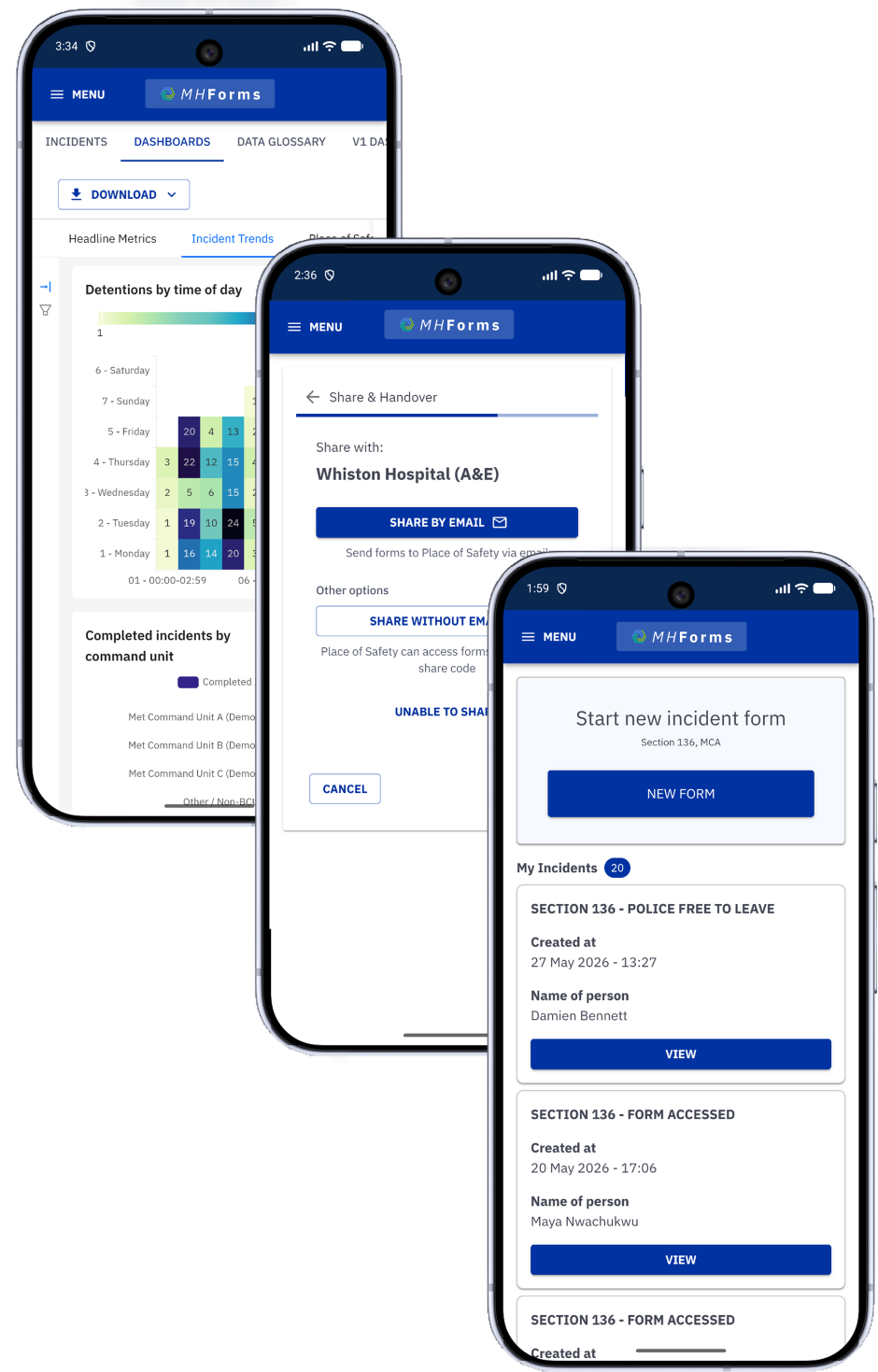
MH Forms enables officers, supervisors and healthcare partners to work from a shared understanding of what is happening in real time, supporting more efficient handovers, better-informed decision-making and improved operational oversight.
Targeted support
Mental health incidents are among the most complex and operationally demanding incidents police forces respond to.
MH Forms supports officers throughout the Section 136 pathway, from detention through to handover, while helping forces build a clearer understanding of how mental health demand presents across their organisation.
By replacing fragmented processes with structured workflows and real-time data, forces can improve consistency, reduce duplication and strengthen collaboration with healthcare partners.
Benefits
- Live visibility of mental health incidents as they unfold
- Improved coordination between police and healthcare services
- Structured handovers that support faster transfer of care
- Real-time supervisor oversight and escalation alerts
- Better quality data to support operational decision-making
- Reduced duplication and administrative burden
- Improved understanding of pathway performance
- Support for Right Care, Right Person implementation
- Enhanced collaboration with NHS partners
- Stronger operational and strategic reporting
Case Study
Metropolitan Police Service (MPS)
The Metropolitan Police Service has worked with Thalamos since 2022 and continues to evolve its approach to digital mental health pathways.
What began as the digitisation of Section 136 processes has developed into a broader focus on operational visibility, pathway management and cross-organisational collaboration. Today, MH Forms supports officers, supervisors and healthcare partners through a shared workflow that helps incidents progress more efficiently while creating a richer operational picture of demand across London.
What we delivered
MH Forms provides the Metropolitan Police Service with a structured digital workflow for recording, sharing and managing Section 136 incidents.
The platform supports secure information sharing, live operational oversight, supervisor escalation, structured handovers and detailed pathway reporting. More recently, additional functionality has been introduced to support richer collaboration between police and NHS teams, including shared activity logs, outcome tracking and enhanced operational dashboards.

How we successfully achieved this
The Metropolitan Police Service was among the first forces to recognise that digitisation is not a one-off project but an ongoing process of improvement.
Successive enhancements have strengthened operational oversight, improved data quality and enabled a more complete view of the pathway from detention through to healthcare assessment and beyond.
This approach reflects a broader recognition that effective mental health response depends not only on good processes, but on having the visibility and information needed to manage them effectively.

Section 136 detentions
Average monthly detentions reduced across two six-month periods.

Ambulance conveyance
Greater use of ambulance transport to health-based places of safety.

Clinical consultation rate
Healthcare professional consultation prior to detention increase.
See how British Transport Police, Metropolitan Police Service and City of London Police are using MH Forms to strengthen mental health crisis response.