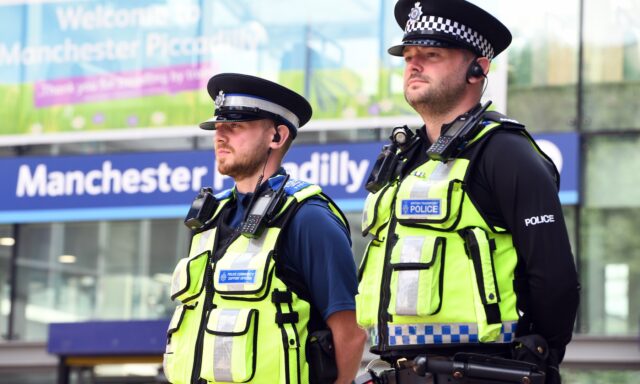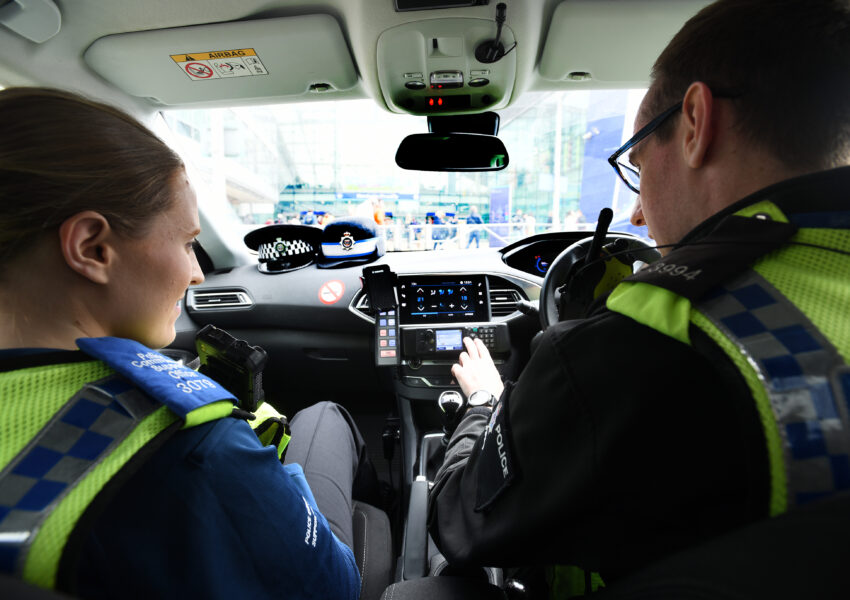
The realities of mental health crisis response are rarely visible from the outside, but they become unmistakable to those who have spent years operating at its fault lines.
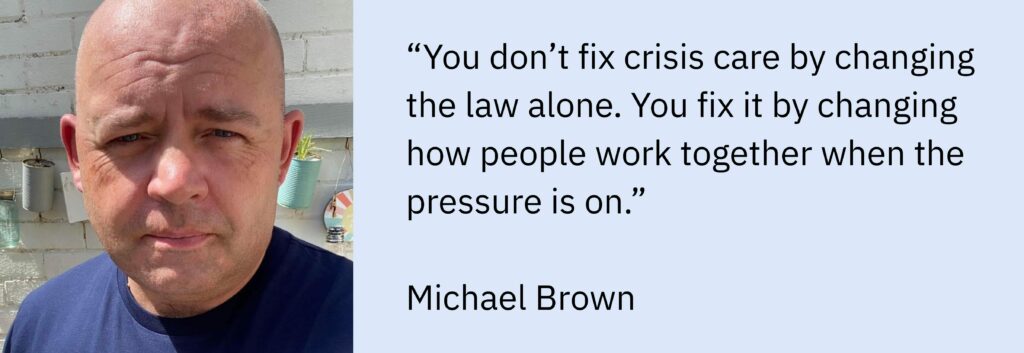
Michael Brown’s career sits across two worlds that too often misunderstand one another. After almost 27 years in frontline policing with West Midlands Police, most of them spent as an inspector, he moved into national policy work as the mental health coordinator for both the College of Policing and the National Police Chiefs’ Council. Today, as a criminology lecturer and PhD researcher, his focus has narrowed further. He is examining deaths following police contact linked to mental ill health, and the uncomfortable question of whether the system truly learns when things go wrong.
That combination of operational experience, national oversight and academic distance gives Brown a rare vantage point. He has seen policing and mental health partnership working from the inside, watched it evolve over decades, and now studies its challenges with forensic care. What emerges is not a story of blame, but of complexity, uneven progress and the persistent gap between legislation and reality.
The myth of a single crisis responder
For many police officers, early exposure to mental health work can create a distorted picture. Brown recalled how easy it is to assume that the police are the default crisis service, simply because of how often officers are called.
“As a police officer coming into this, you can’t help but form the view initially that the police are basically the de facto crisis response to all mental health emergencies in this country,” he said.
That perception is understandable but incomplete. Ambulance services, A&E departments, crisis teams and community mental health services all manage vast volumes of mental health related demand that never touches policing. The difficulty is that capacity, culture and availability vary enormously by place.
“Camden’s not Cornwall and Cornwall’s not Cumbria,” Brown explained. “Urban areas versus rural areas, small towns versus big cities, it all makes a difference to how the thing works.”
The near elimination of police stations as places of safety under section 136 of the Mental Health Act represents real progress, he believes. When Brown first became interested in this work, most people detained under section 136 in his force were taken to custody. Today, almost nobody goes to a police station.
But progress has brought new pressures elsewhere. Around half of all section 136 detentions now go first to A&E. For Brown, that raises uncomfortable questions about whether the system has simply displaced the problem. “A&E are telling us quite loudly and clearly that most of the people being taken under 136 don’t need the specific healthcare that A&E can offer,” he said. “They need a safe place to be assessed by mental health professionals.”
“Officers are often trying to balance safety, legality and humanity in situations where the system hasn’t lined those things up for them.”
Training, law and the limits of policing
One of the most persistent challenges Brown identified is the mismatch between what police officers are expected to do and what the law actually allows them to do. This becomes most acute in private dwellings, where police mental health powers are extremely limited.
“If police officers’ work is the majority of the time in a private dwelling, there’s a real limit to what they can do there,” he added. “Under Section 136, The Mental Health Act doesn’t allow police officers any powers in private premises.”
That legal reality places officers in an impossible position. Faced with someone who appears unwell, lacks capacity and may be at risk, they are often unable to act unless an approved mental health professional is available to apply for a warrant to execute a forced entry under Section 135. Out of hours, that availability cannot be assumed. “You can ring a local authority at two or three o’clock in the morning and find there’s literally no AMHP on duty,” Brown said.
Officers are left navigating risk, legality and moral responsibility. Brown is clear that improvisation, however understandable, carries danger. Historic workarounds that encouraged people to step outside their homes to trigger police powers are unlawful. Yet the alternative, walking away from someone at risk, is often unthinkable.
Training, he believes, is one of the few areas where meaningful improvement is achievable without major structural reform. When Brown joined the police, he received four hours of mental health training. Half of it, he added bluntly, was wrong, and half did not work in the real world.
This lack of legal confidence is not confined to policing. Brown is equally critical of gaps in mental health services’ understanding of police powers, and of the myths that circulate unchallenged across professional boundaries.
When safety and legality collide
Officers are expected to make fast, high stakes judgements in legally complex situations, often with limited information and little support. The fear that a wrong decision could end a career is real, but Brown’s experience suggests that forces are often more supportive than public narratives imply.
His account of the case known as MS versus UK illustrates why. A man detained under section 136 spent more than three days in police custody because the NHS could not agree where to admit him. The conditions were degrading, and rightly condemned by the European Court of Human Rights. But crucially, the legal action was brought against the NHS, not the police.
“The court went out of their way to praise the officers for what they’d actually done,” Brown explained. “The custody record became the evidence of the degradation because the police had documented everything.”
That case underlines a grim truth. Keeping someone safe can sometimes mean operating at the edge of legality. Officers know that coroners are more likely to criticise inaction than imperfect action taken in good faith. “Forces take the view it’s better to keep somebody safe and then answer up for why you kept them safe,” Brown reflected, “rather than explain why you didn’t do something and someone died.”
VIDEO: Michael Brown gives a real-world example of how mental health crisis response decisions made in seconds can be scrutinised for years afterwards
The revolving door of section 136
Few issues generate more frustration across the crisis care system than the repeated use of section 136 for the same individuals. Brown resists simplistic explanations. He noted that even senior legal figures have argued that section 136 is underused, not overused. The real issue, he suggested, is what happens instead.
National data underlines how often section 136 functions as a holding mechanism rather than a gateway into treatment. In recent years, police in England and Wales have used section 136 more than 30,000 times annually. Yet only around one in ten of those incidents results in a formal detention under the Act. In 2023/24, for example, just over 3,200 detentions followed more than 31,000 uses of section 136, a conversion rate of 10.5 percent. The pattern has remained broadly consistent over time, fluctuating between roughly 10 and 12 percent over the past five years.
136 incident statistics
“There are some patients where I’m absolutely satisfied mental health services are correct when they say it’s not doing anybody any favours to detain them again and again,” he said. “But then the question becomes, what do you do instead?”
The answer lies less in new powers and more in communication and trust. Too often, police encounters with known patients are invisible to mental health services, even where those encounters could provide valuable early warning. “If the police had contact with your patient, would you want to know about that?” he asked. “Most services say yes. But then they won’t give the police the information needed to make that happen.”
Consent based information sharing, clearer local agreements and stronger relationships between frontline teams could all help to break the cycle.
“The real question isn’t whether section 136 was used again, but what else was realistically available in that moment.”
Partnership as practice, not policy
Brown’s optimism centres on partnership working done properly. He pointed to a number of forces as examples of more mature collaboration, shaped as much by relationships as by formal structures. “Sometimes a lot of business gets done over a cup of coffee,” he added.
Joint protocols matter, but only if they reflect reality. Brown has seen too many agreements that fail to cover predictable scenarios, such as urgent deterioration in private premises. When that happens, frontline staff are left arguing over responsibility while risk escalates.
One initiative stands out as a model of what is possible. A training programme run by Northumbria Police and the Cumbria, Northumberland, Tune and Wear NHS Mental Health Trust brings police officers, paramedics, AMHPs, nurses and service users together without titles or uniforms. Participants work through evolving crisis response scenarios from different professional perspectives, often discovering how wrong their assumptions about one another have been.
“It makes you stand in the shoes of people who do different jobs,” Brown commented. “It knocks down the idea that the other side are idiots or don’t care.”
For Brown, this kind of shared learning offers something legislation cannot. It humanises decision making, builds empathy and creates the trust needed to operate in the grey spaces where law and life collide. “It’s really easy to hurt people you don’t meet,” he reflected. “That training just knocks that all down.”
VIDEO: Michael Brown expands on why this training works in practice, and what it changes when people meet again in real crisis situations.