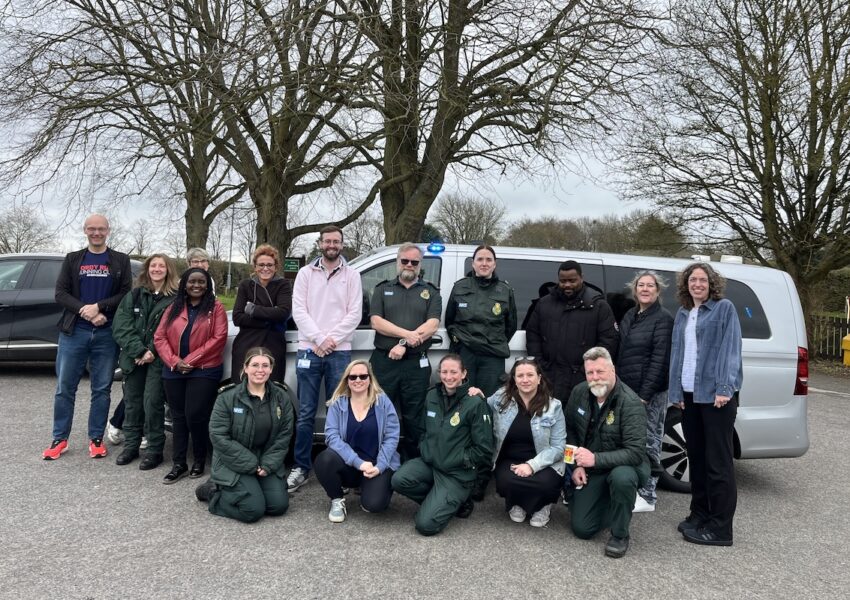
Ambulance services are often the first responders to mental health crises, yet they remain one of the least understood parts of the pathway. Rosie Meadows, Mental Health Advanced Practitioner at East of England Ambulance Service NHS Trust (EEAST), reflected on what crews are encountering and what others in the ecosystem should understand.
Ambulance services sit at one of the most exposed points in the mental health crisis pathway. They are called when situations escalate, when other services are unavailable, or when someone simply does not know where else to turn.
For EEAST, that responsibility extends to one of its most complex duties: providing safe and timely emergency conveyance for individuals detained under the Mental Health Act. The trust is required to ensure transport to an appropriate place of safety using the most suitable vehicle for the circumstances — a task that demands clinical judgement, interagency coordination and, often, resources that are already stretched.
Meadows trained and worked as a mental health nurse before joining the ambulance service. She now works across emergency response, mental health services and wider system coordination, supporting crews across Bedfordshire, Hertfordshire, Cambridgeshire, Norfolk, Suffolk and Essex in a role that includes advising control room clinicians, supporting crews with complex incidents and working alongside police and mental health services.
When emergency medicine meets mental health
Ambulance services were designed to stabilise patients and, if necessary, transport them to hospital. Mental health crises rarely follow that pattern.
“Paramedics go to every job knowing they’ll look to either fix the problem there or take someone somewhere the problem will get fixed,” Meadows explained. “With mental health, it’s not that easy.”
According to a 2023 academic paper, only around 8% of 999 calls involve life-threatening illness or injury, meaning emergency services increasingly respond to complex situations outside traditional emergency medicine. Mental health crises sit squarely within that category: urgent and distressing, but often requiring time, listening and specialist support rather than immediate clinical intervention. A persistent assumption compounds this: that ambulance clinicians are trained mental health specialists.
“There’s a false belief that ambulance crews are trained to deal with mental health,” Meadows said, “and they’re not.”
Crews frequently encounter mental health incidents but receive limited specialist training. “They absolutely want to do the right thing,” she added. “But they don’t always feel they have the knowledge or confidence to make those decisions.”
The reality of triage
Many mental health calls are first assessed through clinical triage, where clinicians attempt to determine the most appropriate response. However, the pathways available are often limited.
The same 2023 study found that more than half of incidents ultimately identified as mental health emergencies were initially coded as physical health problems. The disparity is particularly stark in cases involving anxiety: while less than 1% of calls were coded as anxiety during dispatch, clinicians attending on scene identified it as the primary issue in around 38% of cases.
This reflects the inherent challenge of identifying mental health crises from short phone calls, often from someone other than the patient. When triage clinicians cannot access appropriate mental health services or safely close the call, a traditional ambulance crew attends a mental health crisis where there is no physical health need.
Working across agencies
Mental health emergencies frequently involve multiple organisations. Meadows pointed to the JESIP principles for joint emergency service working as a useful framework, though misunderstandings about roles remain common. She regularly encounters situations where police officers assume ambulance clinicians have powers under the Mental Health Act.
“They don’t,” she said plainly. “Ambulance have no powers under the Mental Health Act.”
That clarity matters, because effective collaboration is built into the model. In line with the National Crisis Care Concordat, the default position is that ambulance services should convey mental health patients to hospital — ensuring ready access to clinical equipment in an emergency, but also achieving parity of esteem with physical healthcare and reducing the risk of stigma. Delivering on that principle requires ambulance services, police, Approved Mental Health Professionals and mental health trusts to work as genuine partners, not parallel responders.
Information sharing presents an equally persistent challenge in that collaboration. Ambulance services, police forces, GP practices and mental health trusts all operate on separate digital systems, and clinicians responding to incidents often have no access to a patient’s background information or care plan. The result is longer job times, more complex decision-making and additional strain on people in crisis who may have to repeat their story multiple times. For Meadows, two improvements would make a significant difference: quick access to key background information, and a way for information gathered during encounters to follow the patient across services.
A different response model
Mental health response vehicles (those pairing an ambulance clinician with a senior mental health practitioner) respond to incidents where specialist expertise is needed and aim to support patients on scene rather than default to hospital conveyance. Because the mental health practitioner is employed by a local trust, they can access patient records and arrange follow-up through crisis teams or community services.
The need for this kind of resource is clear. The 2023 study found around 60% of mental health ambulance attendances resulted in hospital transport. Over the past decade, joint response models have expanded across most regions of England. In London alone, more than 30,000 patients have been seen through joint response cars, with only around 18% conveyed to emergency departments, and earlier national evaluations suggest over 80% of incidents can be resolved at scene.
Yet the model is not secure. Three London Integrated Care Boards have withdrawn funding from crisis car services despite them supporting thousands of incidents each year. There is no national dataset tracking how many response cars are in operation or how they are performing, leaving systems to rely on local evidence when making investment decisions.
Looking ahead
As the system prepares for Mental Health Act reform, Meadows believes success will depend heavily on the conditions facing frontline responders. But without earlier intervention and stronger community services, she fears many people will continue reaching crisis point before receiving help.
“The support people need isn’t there early enough,” she said. “So, they end up in crisis and emergency services become the only place left to go.”
Improving the system will require more than legislative reform. Ambulance services, sitting at the point where many crises first surface, offer some of the clearest insight into where that change is needed most.