
Mental health services are under sustained pressure. Demand is rising, presentations are becoming more complex, and long-awaited reforms to the Mental Health Act are beginning to take shape. On the surface, it is a moment of both urgency and opportunity.
But for Andy Bell, chief executive of the Centre for Mental Health, the most important question is not what is happening within services. It is what is happening outside them.
Because while legislation and service reform matter, they sit at the sharpest end of the system. The bigger determinants of mental health, such as whether people reach crisis point at all, are shaped elsewhere. In social security policy, in housing, in education, and in the wider conditions of people’s lives. Without recognising that, Bell argues, reform risks improving the experience of care for some while leaving the underlying drivers of demand untouched.
What is needed instead is a whole-government approach to mental health. Not as an aspiration, but as a practical way of aligning decisions, resources and responsibility across the system.
Pressure that starts long before crisis
Bell is clear that current pressures on mental health services are both real and deeply embedded. There is “an enormous amount of unmet need” across the population, particularly among younger people, combined with a system that has long been under-resourced relative to that need.
Yet where those pressures are most visible is not where they begin. Rising numbers of people presenting in emergency departments, longer waits, and increasing use of the Mental Health Act are often treated as problems in their own right. In Bell’s view, they are symptoms.
“This isn’t a problem with A&E,” he explained. “It’s not a problem with crisis services.” What it reflects is a gradual erosion of the support that helps people stay well. These are the “buffers” in communities, whether formal services or informal support, that have been reduced or removed altogether. By the time someone reaches crisis point, the opportunity to intervene earlier has often already been missed.
Principles the system struggles to deliver
The reforms to the Mental Health Act are underpinned by clear principles: choice and autonomy, least restriction, therapeutic benefit, and treating the person as an individual. Bell is unequivocal that no mental health professional would reject them. The issue is that the system does not consistently deliver against them in practice.
The evidence of that gap is visible across the pathway. Use of the Act has increased, while disproportionality, particularly affecting Black communities, remains stark. Many people describe experiences of crisis care, especially in inpatient settings, as frightening or even traumatic.
“The very fact that we’ve seen increases in the use of the Mental Health Act,” alongside those inequalities and experiences, “shows that organisationally and institutionally we are not always aligned with those principles.”
Placing them at the heart of legislation is important, but it is only a starting point. Without translating principles into how services are designed, resourced and delivered, they risk becoming statements of intent rather than drivers of change.
For Bell, there is a fifth principle that deserves equal prominence: equity. It shifts the focus from what services are meant to provide to who actually receives support and when. This then brings into view the variation in access, experience and outcomes that sits beneath headline performance measures.
“We don’t want to wait until people are at crisis point to start to offer good quality care,” he explained. That requires decisions about funding and service provision to be made with a population-level perspective, not just a focus on those already within the system.
A system that cannot work in isolation
If the drivers of mental health sit beyond healthcare, so too must the response. Bell is clear that mental health support requires the NHS and local government to work together in an equal partnership alongside the voluntary and community sector. Yet in practice that balance is difficult to achieve. Local government budgets have been significantly reduced, limiting the ability of councils to sustain joint approaches, while structural differences in funding and accountability make genuinely equal partnerships hard to maintain.
Beneath this sits a deeper issue. Mental health is shaped by the conditions in which people live. Housing, employment, relationships and financial security all determine whether someone reaches crisis point. Practical support, such as welfare advice and help with housing, can prevent crises from escalating or support recovery more effectively than clinical care alone.
“Clinical care is important,” Bell added, but it cannot be everything. Without addressing the wider context of people’s lives, the system will continue to operate reactively.
Beyond legislation: a whole-government approach
This is where Bell’s argument becomes most direct. The changes to the Mental Health Act are welcome and necessary, but they are not sufficient.
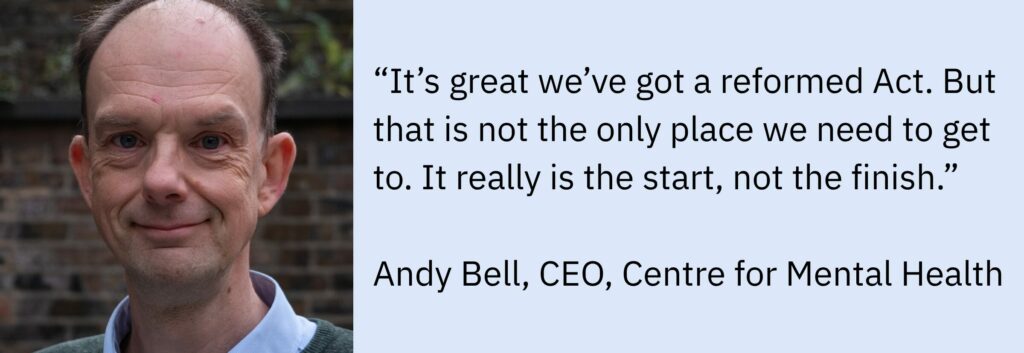
“It’s great we’ve got a reformed Act,” he reflected. “But that is not the only place we need to get to. It really is the start, not the finish.”
The scale of that distinction is significant. The Act affects a relatively small number of people each year, albeit in critical moments. A whole-government approach, by contrast, would shape the mental health of the entire population and recognise that decisions made outside the Department of Health and Social Care, particularly around social security, can have profound impacts on outcomes.
England currently lacks a national mental health plan, in contrast to Scotland, Wales and Northern Ireland. Introducing one would provide a clearer framework for action. A mental health impact test within policymaking could help ensure that decisions across government support, rather than undermine, mental wellbeing. And placing clear responsibility for that coordination at the heart of government would give the approach teeth.
“These are changes that cost virtually nothing,” Bell noted, but could significantly improve how resources are used and outcomes achieved.
Prevention, not just response
At its core, this is an argument about shifting the centre of gravity. Mental health policy has long been dominated by crisis response. A whole-government approach would rebalance that and place greater emphasis on prevention, early intervention, and the conditions that allow people to live well. Over more than two decades, the Centre for Mental Health has built evidence showing that early, flexible support represents better value than delayed, reactive care, improving outcomes and reducing long-term costs.
“This isn’t about saving money,” Bell sud. “It’s about using public money to best effect, to produce the best outcomes for people.”
Looking ahead, Bell identified several markers of meaningful progress: early steps in implementing Mental Health Act reforms; a credible plan to invest in community services; and, perhaps most strikingly, the introduction of access and waiting time standards that place mental health on equal footing with physical health. Standards have been defined by NHS England, but never implemented. Without them, the system continues to operate with an implicit inequality.
“We shouldn’t expect second best for mental health services,” Bell argued. Establishing those standards, even if performance initially falls short, would create the conditions for improvement — much as waiting time targets for elective surgery did from 1997 onwards.
The reforms to the Mental Health Act matter. For those they affect, they will be significant. But if the ambition is to improve mental health outcomes at scale, they are only one part of a much larger picture. The opportunity now is to act on that wider view.