Four Mental Health Trusts demonstrate impact of Thalamos and Rio EPR integration
03 December 2025
At a time when crisis care pressures continue to rise, the ability to move information quickly and accurately through Mental Health Act workflows has never mattered more. A major integration project between eMHA by Thalamos and the Access Rio EPR has now demonstrated how much time and risk can be removed when systems connect properly.
Over the past year, Thalamos has been working in close partnership with four Mental Health Trusts to deploy a new integration between eMHA by Thalamos and the Rio electronic patient record (EPR) system by The Access Group. The aim has been straightforward but significant: eliminate duplication, reduce delays and make Mental Health Act (MHA) workflows quicker, safer and easier for staff across wards, crisis teams and MHA offices.
Thalamos CEO Arden Tomison said the motivation behind the integration has always been practical. “We designed this to remove the everyday frictions that slow teams down. If you make statutory processes easier to manage, you free professionals to focus on the people in front of them. That’s what this integration is delivering.”
That work has now translated into tangible results at scale. Across the four Trusts that went live between November 2024 and October 2025, the combined activity shows how a well-designed integration can meaningfully shift the administrative burden placed on clinical and non-clinical teams.
A year of activity, analysed
The headline figures tell a compelling story. In just 12 months, there have been 10,564 uploads from eMHA directly into Rio. Before the integration, MHA office teams typically spent around 4.8 minutes uploading statutory documents into the EPR. With the integrated pathway, that figure has dropped to 0.8 minutes. When aggregated across thousands of uploads, the time recovered is substantial: the data shows 94 working days saved over the year, or £12,642 in equivalent Band 4 staff time.
Click-through activity tells a similar story. Trust staff clicked through from Rio into eMHA by Thalamos 48,289 times in the same period, enabling them to review and complete documentation without switching systems or chasing information. Before the integration, the average time spent searching for, finding and handling paper or emailed forms was around 3.7 minutes. With the new route, that has been reduced to 0.7 minutes. The combined effect: 302 working days saved and an estimated £97,163 in cost avoidance across Band 4 staff and consultant time.
Together, these two workflows contribute to a projected average annual saving of 163 working days for a single Trust using the integration in full. In cash terms, this equates to around £43,045 of staff time that can be redirected to frontline care, oversight and operational improvement.
Tomison noted that this pattern reflects a wider shift. “The more Trusts digitise Mental Health Act pathways, the clearer it becomes that many of the old delays were never inevitable. They were just a product of systems that didn’t talk to each other. When you join things up properly, you see immediate gains in time, governance and patient safety.”
Steve Wightman, General Manager for Access Health at Access Health, Support and Care, said: “These results show what we can achieve when systems connect properly. The working days saved aren’t just efficiency gains — they represent time that clinical and administrative teams can redirect to patient care. Integrated solutions like this are essential to helping the NHS deliver better outcomes with the resources available.”
Why this matters
The Mental Health Act relies on accuracy, clarity and speed. Every delay in moving paperwork between teams creates risk: missing information, slower decision making, or clinicians spending precious minutes on tasks that do not require their professional training.
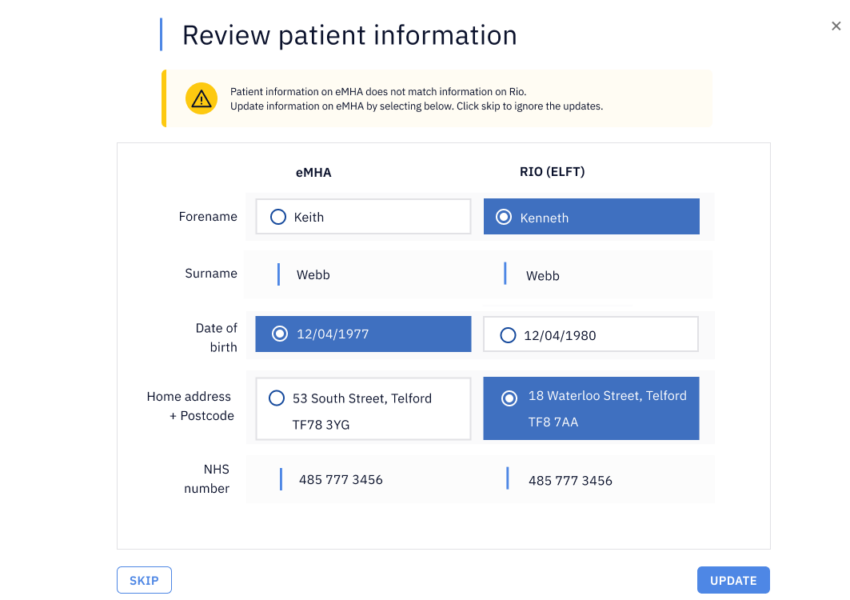
The integration tackles this head-on by allowing eMHA by Thalamos and the Rio EPR to share the same patient information so staff don’t have to type details twice or worry about mismatches. When a user opens a patient in Rio and clicks through to eMHA, the key details such as name, NHS number and demographics are pulled across automatically. If a record already exists in eMHA, the system highlights any differences and asks the user to confirm which version is correct. This keeps both systems aligned and reduces the risk of errors in urgent situations.
Once forms are completed in eMHA, the integration lets staff send the final signed PDF straight back into the patient’s Rio record. This means Mental Health Act documents appear where teams expect them, without anyone needing to manually upload files or switch between systems. Visual prompts in eMHA show when a document has been successfully added to Rio, helping staff stay confident that the right information is in the right place at the right time.
For ward teams, it reduces friction in already stretched environments. For Trusts, it strengthens governance, auditability and data quality. And for MHA offices, it provides the visibility they need to keep processes running smoothly, especially during periods of high demand.
Designed for scale
One of the most encouraging findings from the first year of deployment is the consistency across Trusts. Whether large or mid-sized, each Trust saw similar gains once the integration was active and embedded.
Tomison emphasised that this consistency matters. “Trusts don’t need bespoke solutions for every site. They need reliable, scalable tools that deliver day one value. This integration is already proving that it works wherever teams are using Rio and eMHA together.”
Uploading and retrieving MHA documentation happens thousands of times a year in every Mental Health Trust. Even small improvements in speed and accuracy compound quickly. The integration ensures those gains are captured every time a clinician completes a form, every time an AMHP initiates an assessment, and every time an MHA office processes a detention or renewal.
The technology is available now and is live at scale. Any Trust using eMHA by Thalamos and Rio EPR by The Access Group can adopt the integration, with deployment pathways already established and tested. The Rio EPR system supports over 100,000 clinicians daily, managing care for 39.7 million patients across England.
A step towards a more connected system
At its core, this work is about creating the digital foundations needed for timely, coordinated and safe Mental Health Act practice. By integrating directly with Rio, Trusts are reducing friction in critical legal workflows, freeing up staff time and strengthening the accuracy of patient records.
Tomison sees this as part of a wider direction for mental health care. “Digitisation isn’t about replacing professional judgement. It’s about giving teams the tools to act quickly, confidently and with complete information. That’s how we improve crisis care and, ultimately, outcomes for patients.”
As pressures in crisis care continue to rise, these improvements matter. They represent the type of practical, measurable change that helps teams work more effectively and ensures the MHA can be delivered with the pace and precision it requires.
If you would like to see the workflow end to end, we are offering short demos for Trust digital and operational teams. Book a demo today and see what the integration could unlock for your organisation.